

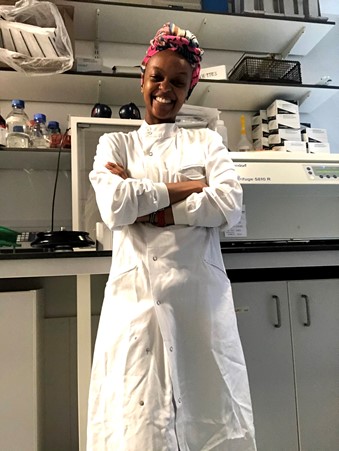
Kawira Mathenge
<p><strong><em><span style="color:#201F1E">Research project title:</span></em></strong><em><span style="color:#201F1E"> </span></em><span style="color:#201F1E">Investigating the role of wildlife in the transmission of Animal trypanosomiasis in Shimba Hills National Reserve, Kwale County, Kenya.</span></p>
<p><em><span style="color:#201F1E"><strong>Research goals:</strong> </span></em><span style="color:#201F1E">Her research focuses on elucidating the importance of sylvatic transmission to animal trypanosomiasis, as well as understanding the transmission of trypanosomes between wildlife and livestock in Shimba Hills National Reserve, allowing animal health agencies to better manage disease risk and better localise and prioritise control strategies.</span></p>
<p><em><span style="color:#201F1E"><strong>Supervisors:</strong> </span></em><span style="color:#201F1E">Dr. Daniel Masiga (Animal Health) and Dr. Andrew Jackson (University of Liverpool)</span></p>
<p><em><span style="color:#201F1E"><strong>Bio:</strong> </span></em><span style="color:#201F1E">Kawira graduated from the University of Nairobi with a Bachelor of Science degree in Biochemistry in 2016. In 2017, she joined <em>icipe</em> as a research assistant in the molecular biology and bioinformatics unit under the supervision of Dr. Dan Masiga. She participated in a study aimed to evaluate t</span><span style="color:#201F1E">he effectiveness of <em>icipe</em>’s tsetse fly repellent technology for controlling Animal African Trypanosomiasis (AAT). Her role was to evaluate the prevalence of trypanosomiasis in cattle enrolled in the study, which took place in the villages around the Shimba Hills National Reserve, Kenya. In 2018, she participated in a collaborative project with the Jackson laboratory (University of Liverpool) where she assisted a post-doctoral fellow from Liverpool in a study aimed at testing an approach<br />
for analysing <em>Trypanosoma congolense</em> variant antigen diversity in sequence data. From this, she was able to receive 6 months training at the University of Liverpool on trypanosome genomics which enabled her to generate and analyse transcriptomes first hand. She won an International Master's Fellowship grant with Wellcome Trust in 2019 and pursed her MSc in Advanced Biological Sciences at the University of Liverpool. She is currently focused on her fellowship project at <em>icipe</em> where she is investigating the role of wildlife in the transmission of AAT in Shimba Hills National Reserve.</span></p>