
Freetown, Sierra Leone, 19 to 21 October 2026: The International Centre of Insect Physiology and Ecology (icipe) participates in the 6th Market for Agricultural Innovations and Technologies (MITA) conference with the theme Agricultural Technologies and Innovations for Animal Production and Integrated Agriculture-Livestock-Aquaculture Systems convened by the West and Central African Council for Agricultural Research and Development (CORAF).
Building on its participation in the 2024 and 2025 MITA conferences, icipe leveraged MITA 2026 to showcase innovative solutions that harness the potential of insects and nature to address agricultural and sustainable development challenges. The conference served as a marketplace to connect with farmers, businesses, entrepreneurs, development and government partners, explore new collaboration opportunities, and expand efforts to bring these solutions to farmers, pastoralists and communities across West and Central Africa.
During the three-day conference, through its exhibition booth and presentations, icipe highlighted practical ways to keep livestock healthy, protect crops from pests, improve farming practices, and use insects to produce animal feed and turn organic waste into useful products. The presentations generated interest among participants, encouraging them to visit icipe’s exhibition booth and engage with the team during business-to-business (B2B) sessions to explore their innovations of interest. These innovations included, Tsetse fly repellent collars (used to repel the flies from biting livestock), milk-drying technology (used to dry and preserve milk in its nutritious form during long dry seasons), Black Soldier Fly farming technology (which transforms suitable organic materials into valuable animal-feed ingredients and organic fertiliser) and the diagnostic tool for nagana or tryp disease caused by tsetse fly bites (a urine-based diagnostic kit which provides rapid, non-invasive detection of the disease in livestock).
Furthermore, as part of the 3rd edition of Abdoulaye Toure Agriculture Innovation Award, icipe launched its Special Award for Insect-Based and Nature-Positive Innovation during the closing ceremony on 21 October 2026. The award marked icipe's contribution to recognising and supporting African innovations that apply insect science to address agricultural, environmental and food-system challenges. In his remark at the conference, Dr Takemore Chagomoka, Head of Innovation Scaling and Business Acceleration, emphasized that the award “... is a statement of our commitment to advancing insect-based and nature-positive solutions, deepening our collaboration with CORAF, strengthening partnerships, and supporting the next generation of African innovators.”
icipe’s involvement in MITA 2026 is central to the broader context of our Vision and Strategy 2026-2030. The Centre’s core ambition is to continue advancing the frontiers of insect science, translate research excellence into impactful solutions that work and engage with strategic partners to expand into other regions in Africa. Therefore, by participating in MITA 2026, the Centre was able to create institutional visibility and strengthen partnerships, particularly with CORAF, deepening our footprint in West and Central Africa.
The Sierra Leone Minister of Agriculture and Food Security, Dr Henry Musa Kpaka addressed the conference on the opening day stating that “For West and Central Africa, [global and development challenges] reinforce the importance of building stronger domestic and regional production systems. We need technologies to allow our farmers to produce more efficiently, manage increasingly the unpredictable conditions and reduce avoidable dependencies on expensive external import.” This not only underscores the relevance of icipe’s work to agricultural development priorities in West and Central Africa, but it also highlights the relevance of its innovations, focus on capacity-building to strengthen local expertise and commitment to sustainable development to contribute to the region’s agricultural transformation.
Participation in the 2024 conference in Lomé and the 2025 conference in Bamako has generated tangible institutional outcomes, including the signing of the CORAF–icipe Memorandum of Understanding, development of a consortium agreement with the Institut Togolais de Recherche Agronomique (ITRA), growing engagement with Food Systems Resilience Programme (FSRP) countries, development of project opportunities, and increased interest in icipe innovations among governments and development partners across the region. Recent engagements with stakeholders in Senegal, Sierra Leone and other FSRP countries have further revealed demand for solutions including Black Soldier Fly waste bioconversion, Push-Pull technology, silkworm production, training of trainers, and technical support for pilots and innovation scaling.
The message from MITA 2026 was very clear. Africa’s agricultural transformation cannot happen in silos. It requires strong partnerships, political will, sustained government and private investment, and deep regional cooperation to scale research-based solutions where it matters most, in the hands of our farmers, pastoralists and communities. icipe is committed to this cause. Building on the connections and opportunities at the conference, icipe will continue to work closely with its partners at CORAF and engage with governments and research institutions to advance the uptake and scaling of the Centre’s proven insect-based and nature-positive innovations.
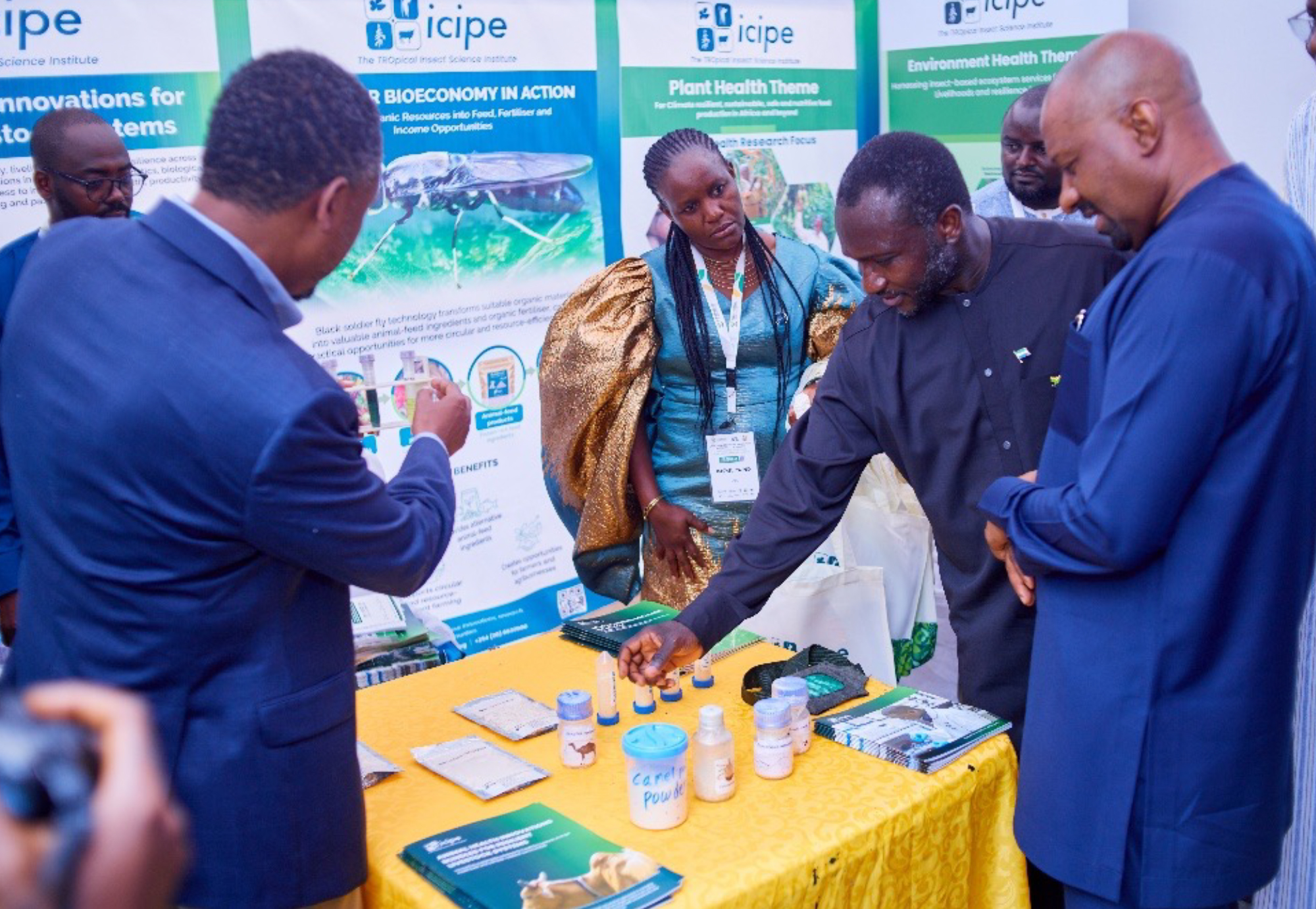
Dr Mohamed Juldeh Jalloh, Hon. Vice President (far right) and Dr Henry Musa Kpaka (right), Minister of Agriculture and Food Security of the Republic of Sierra Leone engage with the icipe team on the Centre’s animal health innovations during a visit to icipe’s exhibition booth on 19 October 2026.