ARPPIS PhD scholar

ARPPIS PhD scholar

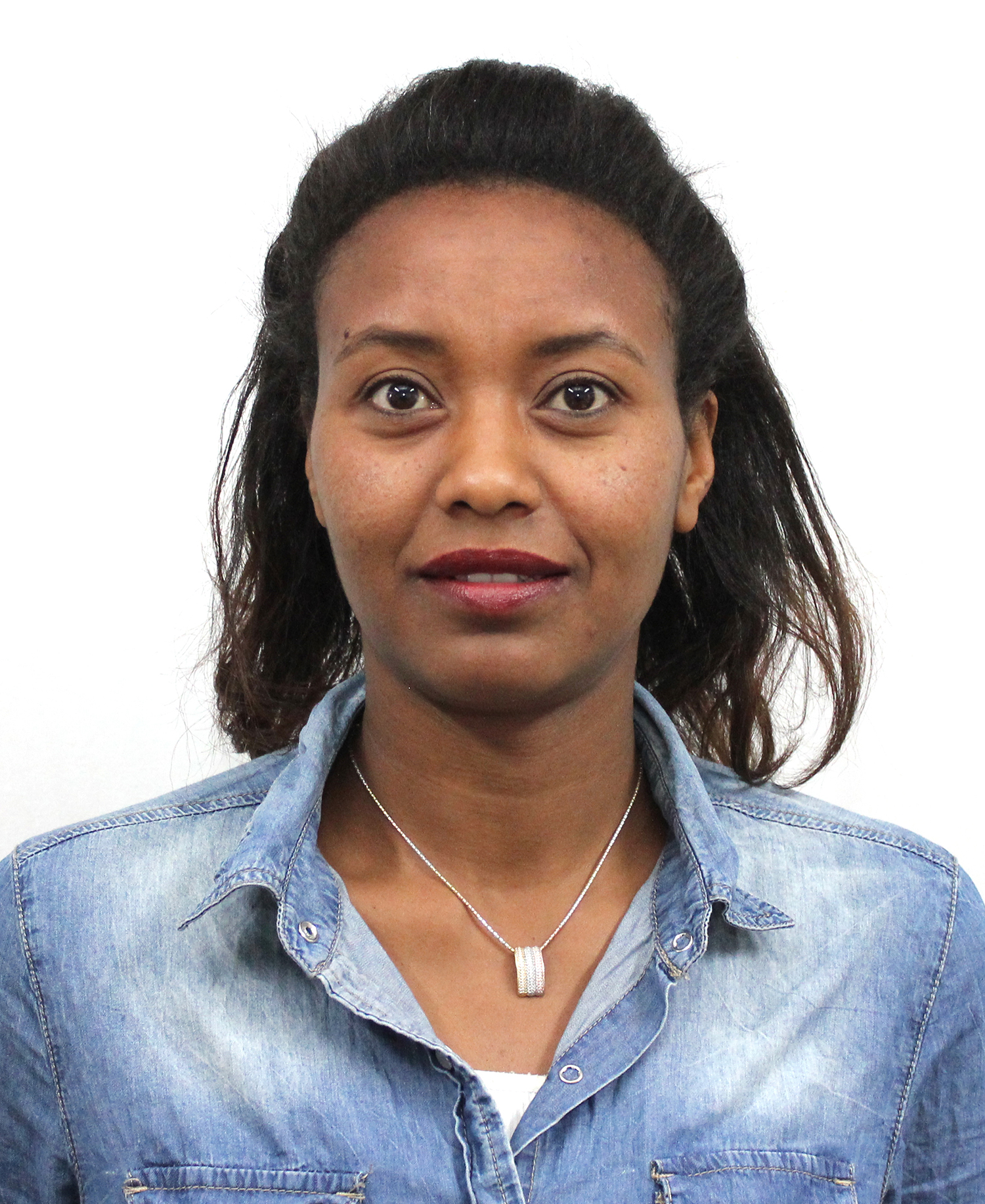
Bethelihem Mekonnen Bekele

<p style="text-align:justify"><strong><span style="font-family:calibri,sans-serif; font-size:11.0pt">Research project:</span></strong><span style="font-family:calibri,sans-serif; font-size:11.0pt">&nbsp; Identification of chemical cues <em><span style="font-family:calibri,sans-serif">Ocephella longonoda </span></em>Trail pheromone which are repellant to fruit flies</span></p> <p style="text-align:justify"><span style="font-family:calibri,sans-serif; font-size:11.0pt">Bethelihem is ARRPIS PhD fellow supervised by Dr Emillie Deletre, Prof. Baldwyn Torto, Dr. Sunday Ekesi and Dr. Thibaud Martin (<em><span style="font-family:calibri,sans-serif">icipe</span></em>). Her research work focuses on the identification of chemical cues of an ant (<em><span style="font-family:calibri,sans-serif">Ocephella longonoda) </span></em>which are repellant to fruit flies. Fruit flies in the family Tephritidae are now a major treat to horticulture production&nbsp;&nbsp; in Africa. These species are highly polyphagous which attack many fruits and vegetables. Ants in addition to their predator behavior on different herbivores they also release trail pheromone which affect the behavior of the flies. Understanding their chemical ecology as it relates to evolution, host selection, reproduction, adult behavior, can be used as an important tool to control and suppress the economic impact of the flies. identifying <em><span style="font-family:calibri,sans-serif">O. longinoda </span></em>repellent semiochemcals will thus be the main purpose of this study. The chemicals will also be used in the field to increase the repulsion in orchards and stimulate the predation behavior, using diffusers.</span></p>

Nancy Karimi Njeru

<p><strong>Reserach project: </strong> <span style="color:#404040; font-family:calibri,sans-serif; font-size:12.0pt">Towards understanding the role of push-pull cropping system in management of mycotoxins in maize in East Africa.</span></p> <p><span style="color:#404040; font-family:calibri,sans-serif; font-size:12.0pt">Nancy is an ARPPIS PhD fellow supervised by Prof. Zeyaur R. Khan and Dr Charles A. Midega of icipe, Kenya. Her research interests include plant health and food safety and security. She is currently doing research on the role of push-pull cropping system in management of mycotoxins in maize in East Africa.&nbsp; Maize is one of the staple foods in Sub-Saharan Africa. However, insect pests and diseases are a major constraint to its production. Infection of maize by various fungal pathogens results in contamination of maize grains with mycotoxins. It is estimated that about 40% of grain losses in Sub Saharan Africa are due to mycotoxins. Cropping systems that help manage insect pests and improve soil health may potentially contribute to the management of ear rots, a fungal disease that contaminates maize with mycotoxins, and subsequently mycotoxin contamination of maize. This study assesses the role of push-pull cropping system in management of mycotoxins in maize in East Africa. The push-pull technology is a strategy for controlling agricultural pests by using repellent "push” plants and trap” pull" plants. The technology involves of behavior modifying stimuli to manipulate the distribution and abundance of a pest.&nbsp; Nancy completed her MSc in Microbiology at the University of Nairobi, Kenya. </span></p>

Abdullah Mkiga

<p><strong>Research Project: </strong>Bio-ecology of the false codling moth, <em>Thaumatotibia leucotreta</em> and its associated natural enemies on citrus in Kenya and Tanzania and implication for its management</p> <p>Abdullah is an ARPPIS PhD Scholar supervised by Dr Samira Mohamed (<em>icipe</em>). Abdullah’s research interests include the insect biology, ecology and sustainable pest management. His PD research focuses on the false codling moth (FCM) <em>Thaumatotibia leucotreta</em>, one of the major constraints to citrus production. Information on the bio-ecology of FCM and natural enemies is crucial for sound and sustainable management of this pest. The research will establish the genetic diversity, distribution, host range, dynamics, and damage levels of <em>T. leucotreta</em> in Tanzania, catalogue natural enemies and determine their efficiency in suppressing <em>T. leucotreta,</em> and conduct life table studies and develop predictive phenology models for <em>T. leucotreta</em>.</p> <p>Abdullah holds a BSc in Agriculture and a MSc in Crop Science from Sokoine University of Agriculture, Tanzania.</p>

Hellen Butungi

<p><strong>Research project:</strong> Insect-endosymbiotic spiroplasmas of anopheline mosquitoes and their effects on host vectorial capacity</p> <p>Hellen is an ARPPIS PhD Scholar supervised by Dr Jeremy Herren (<em>icipe</em>) and Prof. Lizette Koekemoer (University of the Witwatersrand, South Africa). Hellen’s research interests include pathogen-vector-host interactions, and the use of molecular, microbiological and bioinformatics tools to understand the underlying mechanisms of vector responses in highly pathogenic, endemic environments. She is currently researching on endosymbiotic bacteria, specifically spiroplasmas that are associated with anopheline mosquitoes, which are thought to have some impact on vector biology and transmission of pathogens. This research will contribute knowledge on the use of naturally occurring endosymbiotic microbes to manage vector-borne diseases of Africa such as malaria by reducing vector abundance or preventing transmission of pathogens by the vectors. Hellen is registered for a PhD at the University of the Witwatersrand and is supported by a scholarship from DAAD.</p> <p>Hellen holds a BSc in Biochemistry from Makerere University, Uganda and a MSc in Bioinformatics from the University of Nairobi, Kenya. She is a student member of the International Society for Computational Biology (ISCB).</p> <p>&nbsp;</p>

Yvan Ritter Guimapi

<p><strong>Research project:</strong> Development and implementation of software to optimize field application of biopesticides for the management of arthropod pests</p> <p>Rittter is an ARPPIS PhD Scholar supervised by Dr Samira Mohamed (<em>icipe</em>) and Dr George Okeyo (Jomo Kenyatta University of Agriculture and Technology (JKUAT), Kenya). He is currently researching the modeling of arthropod dispersal, to develop and implement a software to optimize field application of biopesticides for the management of arthropod pests. He is currently registered for a PhD at JKUAT, and is supported by a scholarship from DAAD.</p> <p>Ritter completed his undergraduate studies in Mathematics and Computer Science, at University of Dschang, Cameroon and obtained a MSc in Computer Sciences from the University of Yaounde I, Cameroon. Ritter serves on the <em>icipe</em> Scholars Association committee as the PhD representative.</p> <p>&nbsp;</p>

Pamela Ochungo

<p><strong>Research project: </strong>Investigating the link between landscape and pollination effects for enhanced hive productivity</p> <p>&nbsp;</p> <p>Pamela is an ARPPIS PhD Scholar supervised by Dr Tobias Landmann (<em>icipe</em>). Pamela’s research interests include the application of geographic information system (GIS) and remote sensing analysis techniques to research and development projects in developing countries. Of particular interest is the use of spatial modeling for enhanced understanding of complex interrelated processes. She is currently researching the link between landscape and pollination effects, a study that aims to assess the value of the landscape for beekeeping using pollination efficacy as the key measure. She is supported by a scholarship from DAAD.</p> <p>Pamela completed her undergraduate studies in Engineering Surveying at the University of Nairobi, Kenya, and obtained a MSc in Geographic Information Science from Manchester Metropolitan University, UK. Pamela is a member of the Society for Conservation GIS (SCGIS), Kenya.</p> <p>&nbsp;</p> <p>&nbsp;</p>